

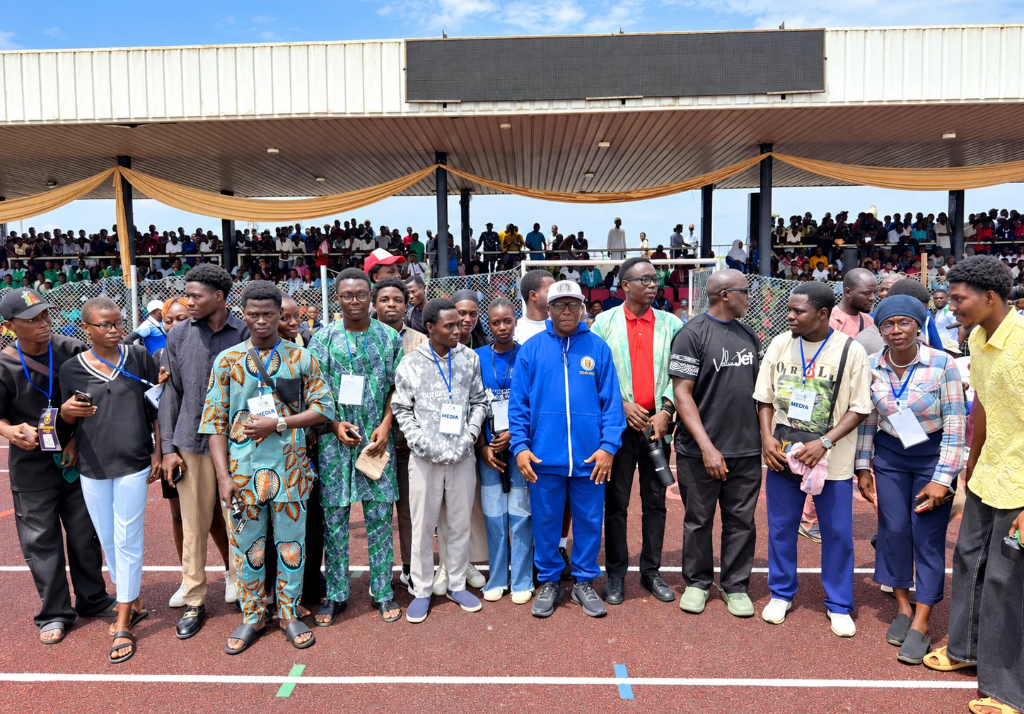
WAUG 2026: The Volunteers Who Told the Story of the Games
Across the courts, pitches and arenas of the Obafemi Awolowo University (OAU) Sports Centre, a team of young volunteers worked behind the scenes to document the West Africa University Games. Their experiences revealed the importance of sports media, the opportunities volunteering creates, the challenges that comes with doing the work and the spiraling effects of the NUGA Volunteer Network.
Through digital media, videos, photographs and stories, these volunteers ensured that the competition travelled beyond the location where it took place. The team comprising of videographers, editors, photographers, writers, creative designers, data handlers and social media handlers moved between venues to record the action and prepare footage, infographics, reports for publication to audiences within and beyond West Africa University Sports.
For one of the media team leads, Olakunle Daniel Longe, the experience was a clear demonstration of how much the success of a major sporting event depends on the media quality. Yet, leading a team of volunteers also brought with it challenges that went beyond the demands of producing content. "Leading a team of volunteers can be a bit of a problem at times considering that they are not being pair" Olakunle admitted.
He recalled having to go an extra mile to ensure that his team members stayed motivated and committed in delivering the media team's assignment .
Regardless of the difficulties encountered, the media unit found ways to keep the work moving. Olakunle credited the social media handlers, graphic designers, videographers and data team members with helping to sustain the flow of content throughout the Games. The results of the work done were significant. He estimated that the unit generated between 400,000 and 600,000 impressions across social media platforms within five to seven days.
Another team member, Faridat Oluwakemi Qowiyu from the University of Lagos, who managed the Games' X account said that the international character of the competition made the assignment different from her usual work. "It's something big" she said of the reach achieved. "The West Africa University Games brought different West African universities together. So it was not the usual social media handling that I was already used to".
She wasn't dealing with a Nigerian audience. Faridat had to communicate with audiences across different countries which included finding the correct social media handles for participating institutions. Faridat believes that the media team's contribution was very vital to the success of the Games. "I believe the media team contributed immensely to the success of these games, in the sense that if the media team were not in existence, then the games would have no visibility" she said. She also acknowledged the graphic designers, data team, videographers and content creators whose work supported the social media operation.
At the Games, another group of media volunteers were concerned with capturing the moments that would eventually become the Games' visual evidence. Olajide Oluwagbenga, a professional photographer and a graduate of OAU led the photography unit. He described a demanding routine that required him to coordinate fellow photographers as they covered the competition venues across the university's sports centre.
"It was interesting but at the same time hectic" he said. "I had to sleep over on campus during the games. Also as team leader, I had to go around all the sports venues. Even after appointing someone to go there, I still had to go there again to check myself".
With limited personnel and several competitions taking place, coordination became essential. The photographers were assigned to venues thus ensuring that all the action was covered. Furthermore, a standby editor helped speed up the process. Rather than waiting until the end of each day's work, photographers could return to the media centre during breaks, transfer their images and allow editing to begin as the competitions across the different sports progressed. This approach helped the team produce a steady supply of photographs despite its limited numbers.
The need for documentation was perhaps the most important point for Oluwagbenga. "You can't do a big event like this without the media" he said. "After the whole event, you need memories and you can't have memories without media".
That emphasis on documentation also shaped the work of Banwo Oluwapelumi Aina, a fourth year Human Kinetics student at the University of Ibadan. Working as a videographer, video editor and TikTok manager, she built upon her earlier experiences with the NUGA Volunteer Network to carry out her responsibilities at the Games.This previous experiences had helped her develop the skills that enabled her to combine several roles during WAUG 2026.
"What is the evidence that something happened here in Ile-Ife in 2026? She asked as an explanation of the importance of the media team's work. "We as the media team made it happen. How? Because we made sure that videos were available, edits were available, things that the athletes could use in their journey especially when they are going pro"
According to her, media content is not simply a means of entertaining audiences or keeping the Games' social media platforms active. It could also serve as a record of an athlete's development, offering material that competitors and coaches could retain beyond the event.
Away from the cameras, Aremo David Opeyemi, a third year pharmacy student who worked as a content writer helped in translating action at the competition into stories and captions for graphic designers and social media handlers. His participation at the Games reflected an interest that one could describe as worlds-apart from his course of study. However, he saw the Games as an opportunity to learn, contribute and explore a place for himself in sports media. "It's a niche that is not common" he said of combining pharmacy with sports media. "I love the media space and I felt that these West Africa University Games were a platform for me to learn and add my own quota". He added that irrespective of the course he was studying, volunteering at the games was proof that he could successfully explore his other interests and not be limited.
Volunteering, for everyone on the media team was an opportunity to serve at the Games and develop professionally. Yet their reflections also revealed a very common tension associated with volunteering: combining the willingness to serve as a volunteer alongside the likelihood of an absence of incentives or rewards.
Faridat, who described herself as a serial volunteer, urged young people to approach volunteering from a service mindset rather than from what they could get from it. Oluwapelumi offered a different but complementary view. "Volunteering is voluntary" she said. "It is something that has to come from your heart. That's the only way you can maximize it especially when the conditions are not what you were looking forward to".
In the future when a conversation about WAUG 2026 arises, attention will naturally be around the athletes who dominated and their respective institutions but the photographs, videos, data and reports that preserved those achievements will also form part of the Games' legacy.
The media volunteers have contributed immensely to the success, helped create a lasting documentation of the games and their contribution has now contributed to the growing evidence of the progress achieved and impact being made by the NUGA Volunteer Network.
By Victor Oluwaseun Olabisi
Comments (0)